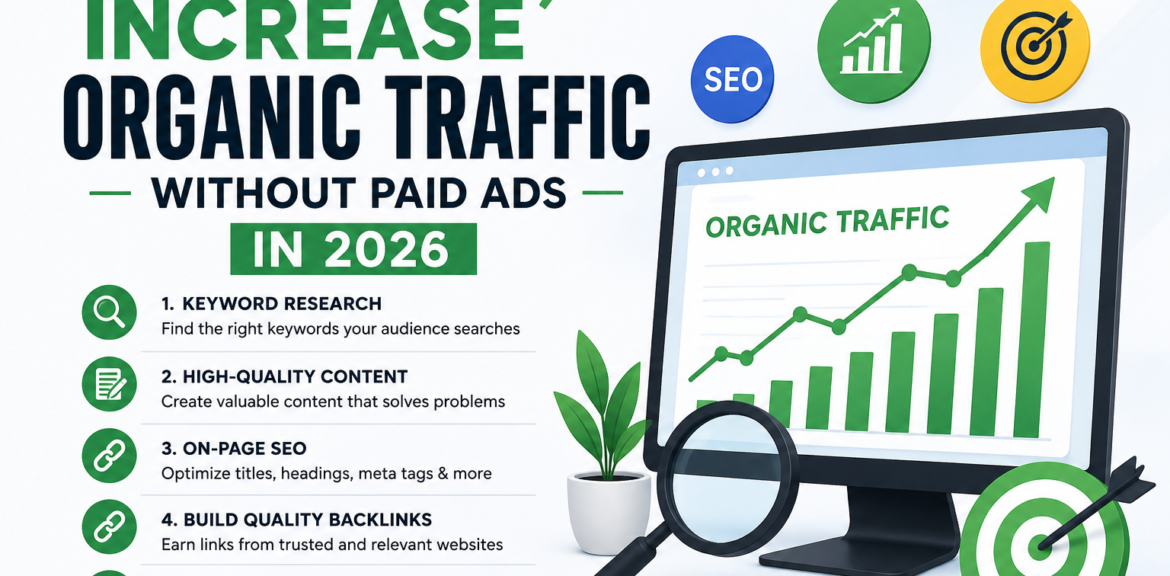

Introduction
Every website owner wants more visitors, but not everyone has the budget to invest in paid advertising. Fortunately, you don’t need Google Ads or social media campaigns to grow your website. By focusing on search engine optimization (SEO), creating valuable content, and improving your website’s user experience, you can attract a steady stream of organic traffic that continues to grow over time.
Organic traffic refers to visitors who find your website through unpaid search engine results. These users are actively searching for information, products, or services, making them more likely to engage with your content and become customers. While building organic traffic takes time, the long-term benefits far outweigh the cost of paid advertising.
In this guide, you’ll learn practical and proven strategies to increase your website’s organic traffic without spending money on ads.
What Is Organic Traffic?
Organic traffic is the number of visitors who land on your website by clicking on unpaid search results from search engines such as Google, Bing, or Yahoo. Unlike paid traffic, organic traffic is earned by creating high-quality content and optimizing your website for search engines.
For example, if someone searches for “best SEO tips for beginners” and clicks your blog because it appears in Google’s search results, that visit is considered organic traffic.
The biggest advantage of organic traffic is that it continues to generate visitors long after your content is published, making it one of the most cost-effective digital marketing strategies.
Why Organic Traffic Matters
Organic traffic is valuable because it helps businesses build long-term visibility and credibility online. Visitors who arrive through search engines usually have a clear intent—they are looking for answers, products, or solutions.
Some key benefits include:
- Consistent website visitors without paying for every click.
- Higher trust because users often prefer organic results over advertisements.
- Better return on investment over time.
- Increased brand awareness and authority.
- More qualified leads and conversions.
Instead of relying on advertising budgets, investing in SEO creates lasting growth for your website.
1. Perform Smart Keyword Research
Find Keywords Your Audience Actually Searches
Keyword research is the foundation of every successful SEO strategy. Before writing any content, identify the phrases your target audience uses when searching online.
Focus on long-tail keywords because they are less competitive and often have higher conversion rates.
For example, instead of targeting a broad keyword like “SEO,” consider phrases such as:
- How to increase organic traffic
- SEO tips for small businesses
- Best free SEO tools
- Website SEO checklist
These keywords are more specific and better match user intent.
Understand Search Intent
Not every keyword has the same purpose. Some users are looking for information, while others are ready to make a purchase.
Before creating content, analyze the top-ranking pages for your target keyword. If users are looking for guides, write a detailed guide. If they want product comparisons, create comparison content.
Matching search intent increases your chances of ranking higher on Google.
2. Create High-Quality Content That Solves Problems
Google rewards content that provides genuine value to users.
Instead of writing short articles filled with keywords, create comprehensive content that answers common questions and provides actionable solutions.
Your content should:
- Answer the reader’s questions clearly.
- Include practical examples.
- Be easy to read.
- Offer updated information.
- Cover the topic in depth.
When readers spend more time on your website because your content is helpful, search engines recognize those positive engagement signals.
3. Optimize Every Page for On-Page SEO
On-page SEO helps search engines understand what your content is about.
Make sure every page includes:
- A compelling SEO title.
- A clear meta description.
- One H1 heading.
- Well-structured H2 and H3 headings.
- Relevant keywords used naturally.
- Internal links to related pages.
- Optimized image alt text.
- Short and descriptive URLs.
Avoid keyword stuffing. Instead, write naturally while covering the topic comprehensively.
4. Improve Website Speed
Website speed is an important ranking factor and directly affects user experience.
A slow-loading website often causes visitors to leave before the page finishes loading, increasing bounce rates and reducing conversions.
You can improve website speed by:
- Compressing large images.
- Using browser caching.
- Choosing reliable hosting.
- Reducing unnecessary plugins.
- Minimizing CSS and JavaScript files.
- Using a Content Delivery Network (CDN).
A faster website keeps users engaged and helps improve search rankings.
5. Build a Strong Internal Linking Structure
Internal links connect related pages on your website, helping both users and search engines navigate your content more effectively.
For example, if you publish an article about keyword research, link it to related posts such as:
- On-Page SEO Guide
- Technical SEO Checklist
- Best SEO Tools
- Local SEO Strategies
Internal linking distributes authority across your website and encourages visitors to explore more pages.
6. Earn High-Quality Backlinks
Backlinks remain one of the strongest ranking signals in SEO. A backlink is a link from another website pointing to your content.
Rather than buying links, focus on earning them naturally by:
- Publishing original research.
- Writing comprehensive guides.
- Creating useful infographics.
- Guest posting on reputable websites.
- Sharing expert insights.
Quality backlinks from trusted websites improve your website’s authority and increase your chances of ranking higher.
7. Keep Your Content Updated
SEO is not a one-time task. Search engines prefer fresh and relevant content.
Review older articles regularly and update them by:
- Adding new statistics.
- Including recent examples.
- Improving readability.
- Expanding sections with additional information.
- Fixing outdated links.
Refreshing old content can often improve rankings faster than publishing brand-new articles.
8. Optimize for Mobile Users
Most users browse the internet using smartphones, making mobile optimization essential.
Ensure your website:
- Uses a responsive design.
- Loads quickly on mobile devices.
- Has readable text without zooming.
- Includes clickable buttons with enough spacing.
- Provides an easy navigation experience.
A mobile-friendly website improves both user satisfaction and search performance.
9. Track Your SEO Performance
Monitoring your SEO efforts helps you understand what’s working and where improvements are needed.
Use tools such as Google Search Console and Google Analytics to track:
- Organic traffic growth.
- Keyword rankings.
- Click-through rates.
- Bounce rate.
- Top-performing pages.
- Indexing issues.
Regular analysis allows you to refine your strategy and achieve better results over time.
Common Mistakes to Avoid
Many websites struggle because they make avoidable SEO mistakes.
Some of the most common include:
- Ignoring search intent.
- Publishing duplicate or thin content.
- Using too many keywords unnaturally.
- Neglecting technical SEO.
- Having a slow website.
- Forgetting internal links.
- Never updating old articles.
Avoiding these mistakes can significantly improve your website’s long-term performance.
Frequently Asked Questions
How long does it take to increase organic traffic?
SEO is a long-term strategy. Most websites begin seeing noticeable improvements within three to six months, depending on competition, content quality, and consistency.
Is organic traffic better than paid traffic?
Organic traffic provides long-term value because it continues generating visitors without ongoing advertising costs. Paid traffic stops as soon as your advertising budget ends.
How often should I publish new content?
Publishing one or two high-quality articles each week is a sustainable strategy for most businesses. Consistency is more important than quantity.
Can small businesses compete with large websites?
Yes. By targeting specific keywords, focusing on local SEO, and creating helpful content, small businesses can compete successfully in search results.
Final Thoughts
Increasing organic traffic without paid advertising requires patience, consistency, and a user-first approach. Focus on understanding your audience, choosing the right keywords, creating valuable content, optimizing your website, and continuously improving your SEO strategy.
Remember that sustainable SEO success doesn’t happen overnight. Every optimized page, every helpful article, and every quality backlink strengthens your website’s authority. By consistently applying these best practices, you’ll build a steady flow of organic traffic that supports your business growth for years to come.