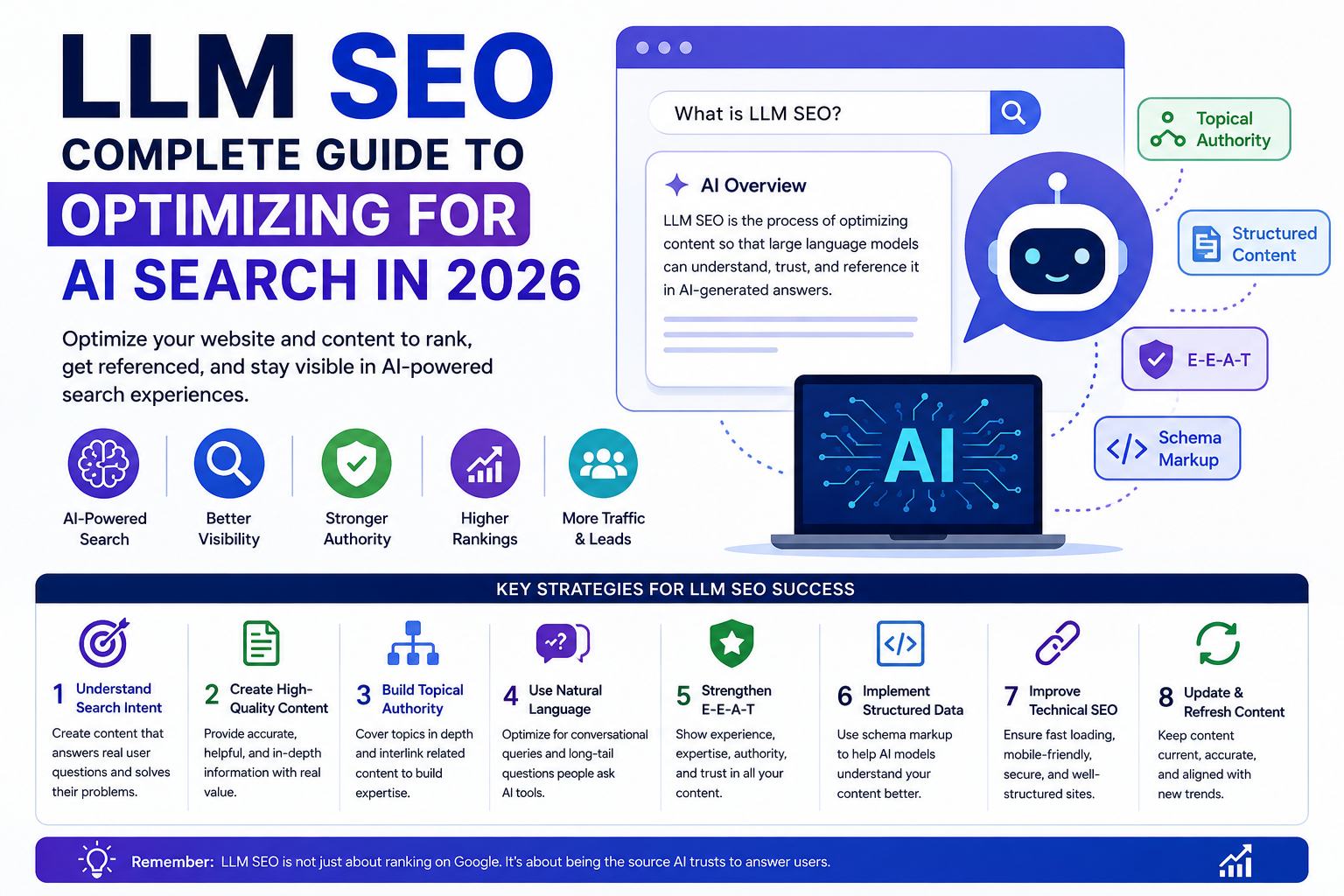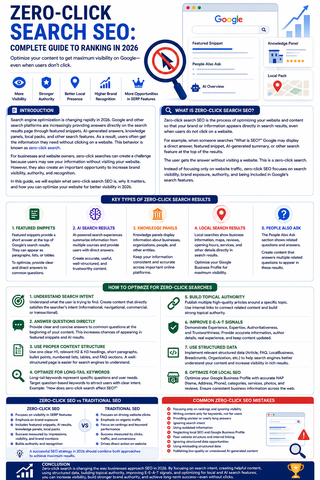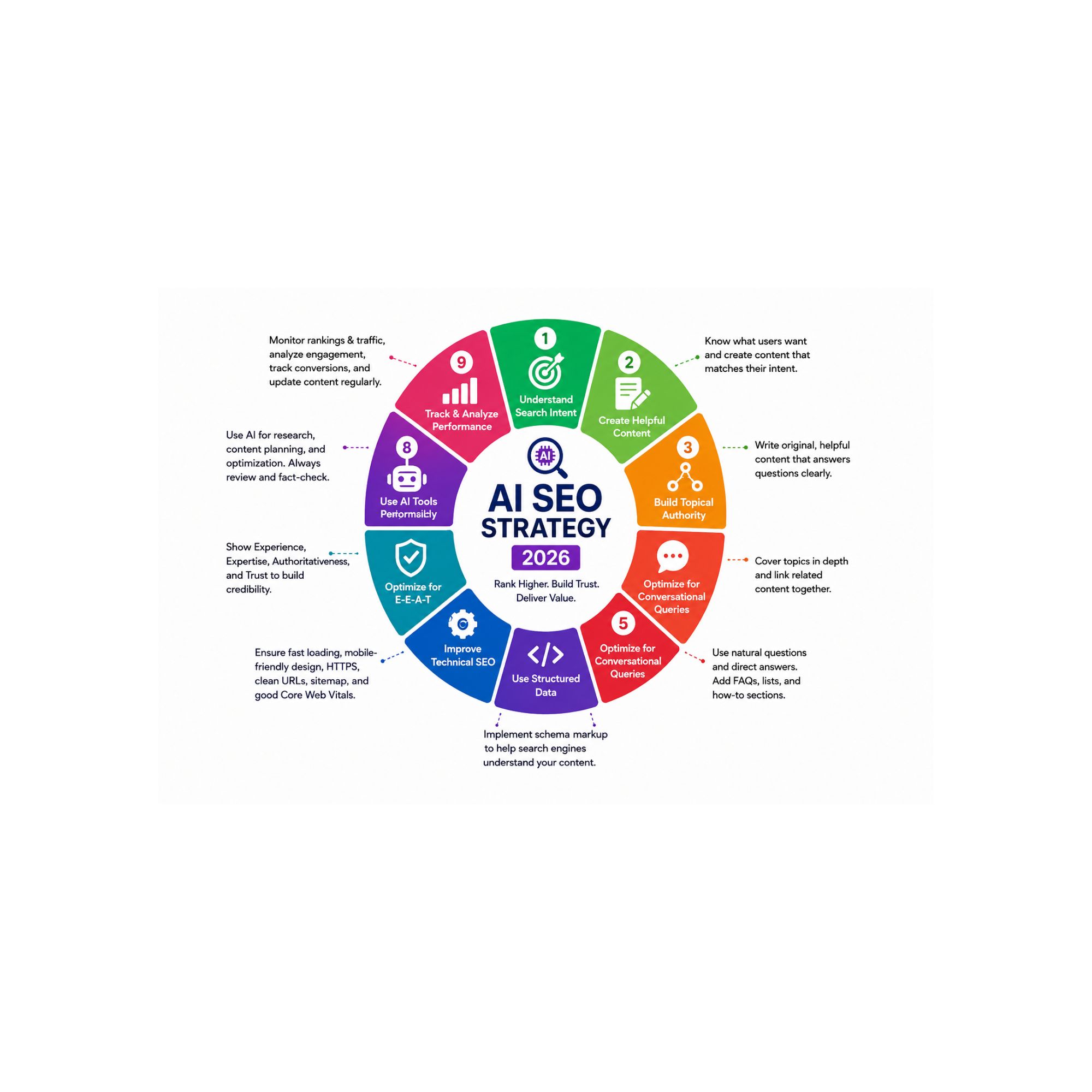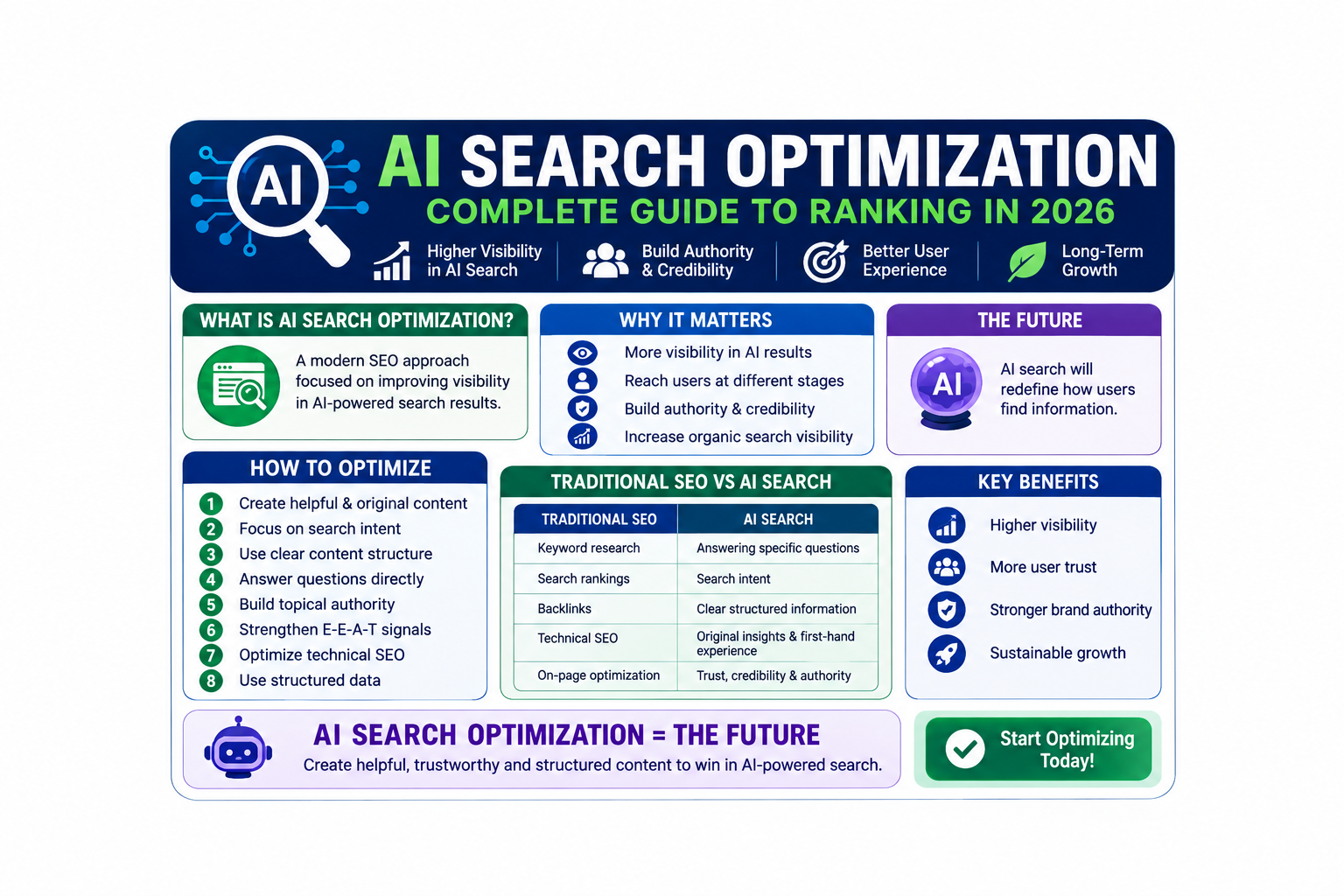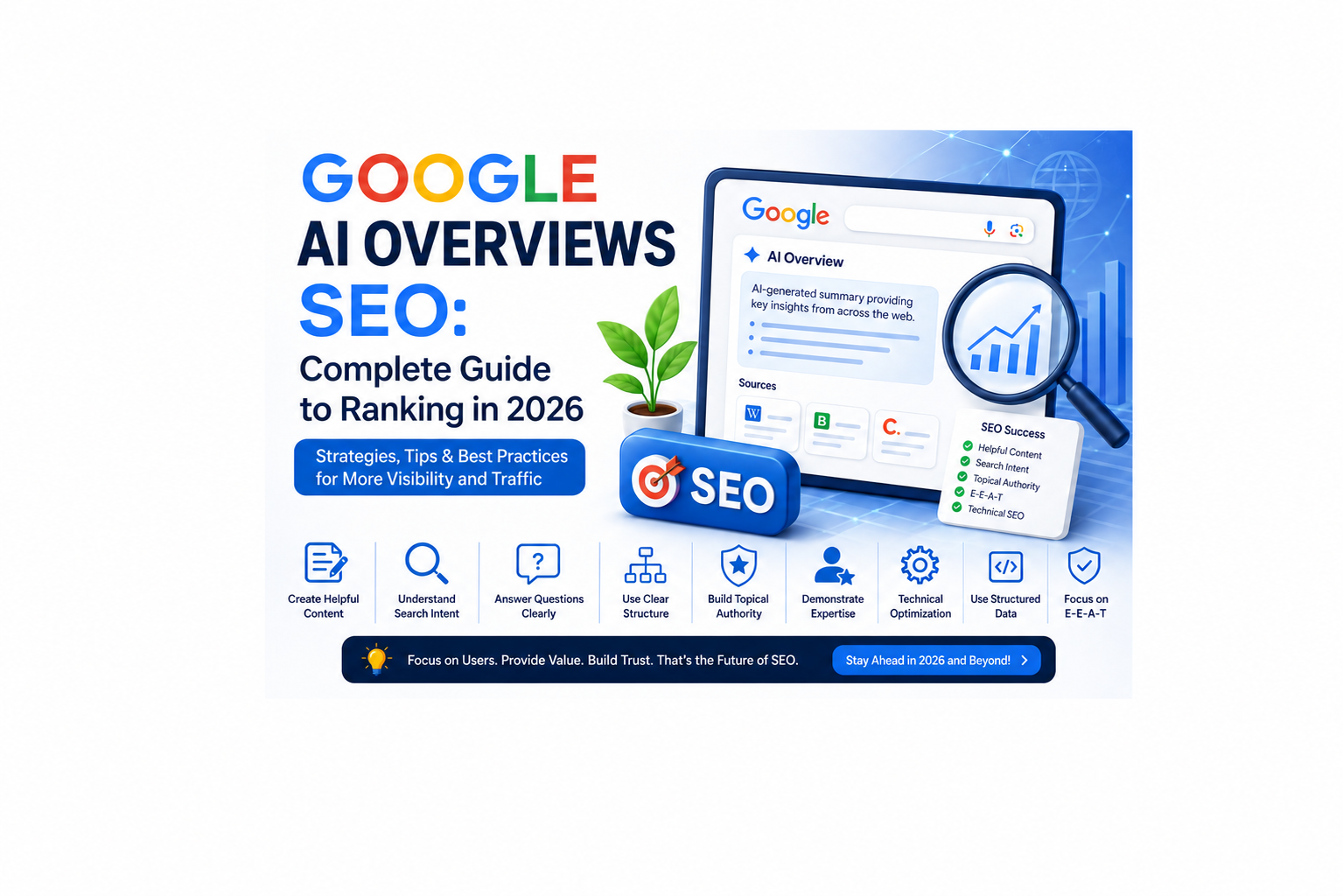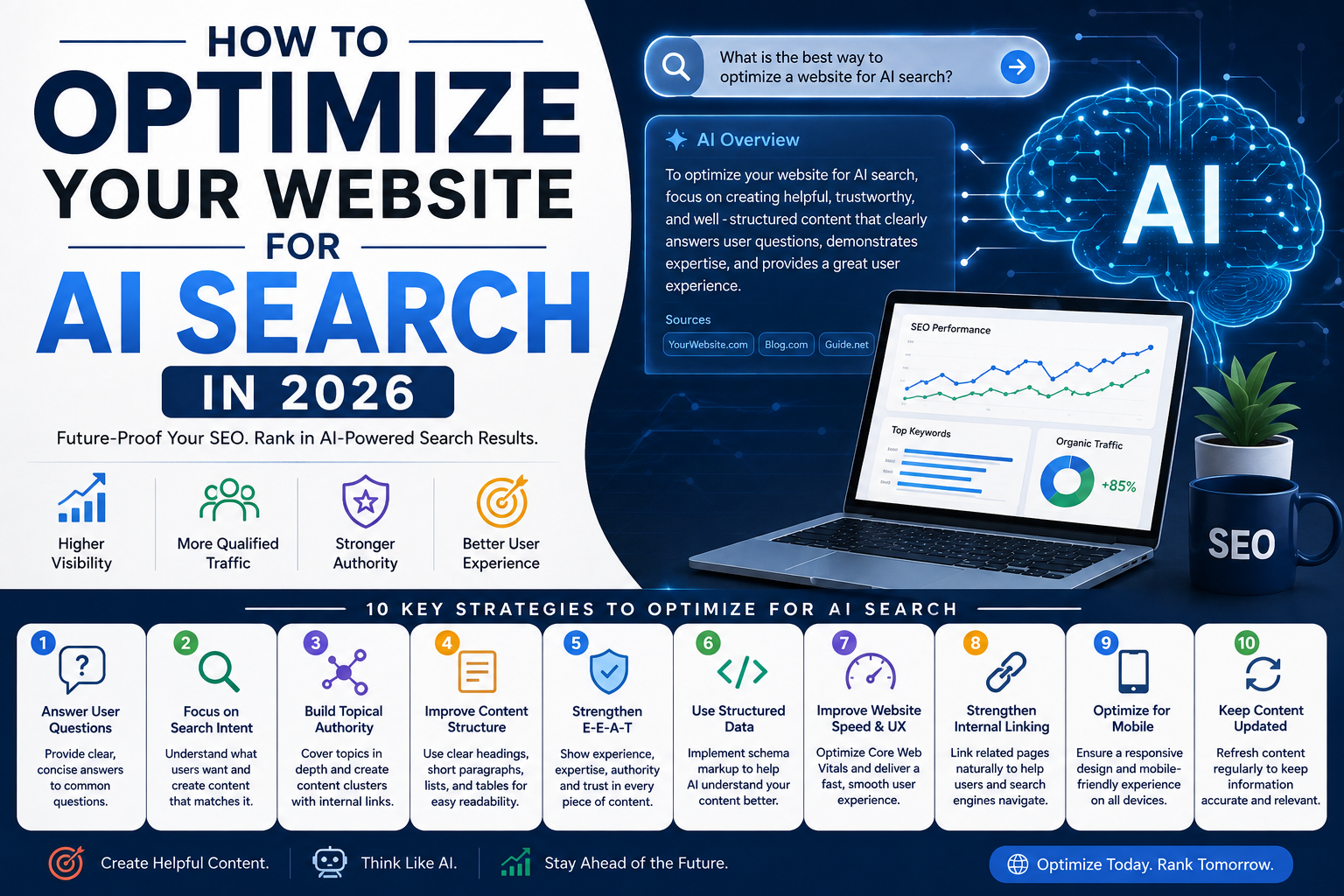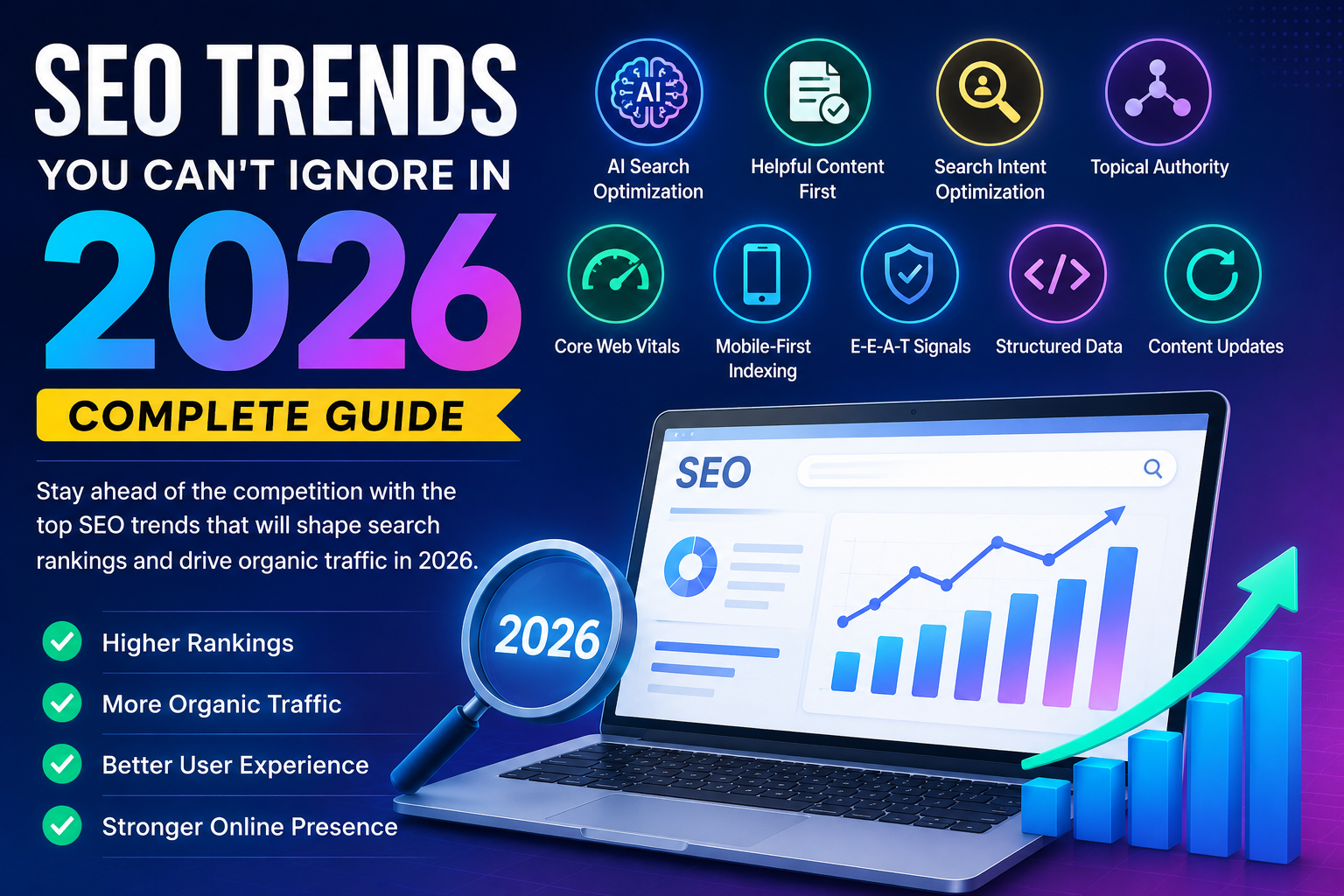

Search is changing rapidly in 2026. People are no longer relying only on traditional search engines to find information. AI-powered search tools such as ChatGPT, Google’s AI features, Gemini, and Perplexity are increasingly being used to answer questions, compare products, summarize information, and discover businesses.
This shift has introduced a new approach called Generative Engine Optimization (GEO). While SEO (Search Engine Optimization) focuses on improving a website’s visibility in traditional search results, GEO focuses on increasing the chances of a brand or website being mentioned and cited in AI-generated answers.
So, what is the difference between GEO and SEO, and which one should businesses focus on in 2026? Let’s explore.
What Is SEO?
SEO stands for Search Engine Optimization. It is the process of optimizing a website so that it can rank higher in traditional search engine results.
SEO focuses on helping search engines understand a website’s content and determine its relevance and quality for specific search queries.
Important SEO activities include:
- Keyword research
- On-page optimization
- Technical SEO
- Content optimization
- Internal linking
- Backlink building
- Image optimization
- Improving website speed
- Optimizing title tags and meta descriptions
- Creating helpful and original content
For example, if someone searches for “best SEO services for small businesses,” an SEO strategy aims to help a website appear prominently in Google’s traditional search results.
What Is GEO?
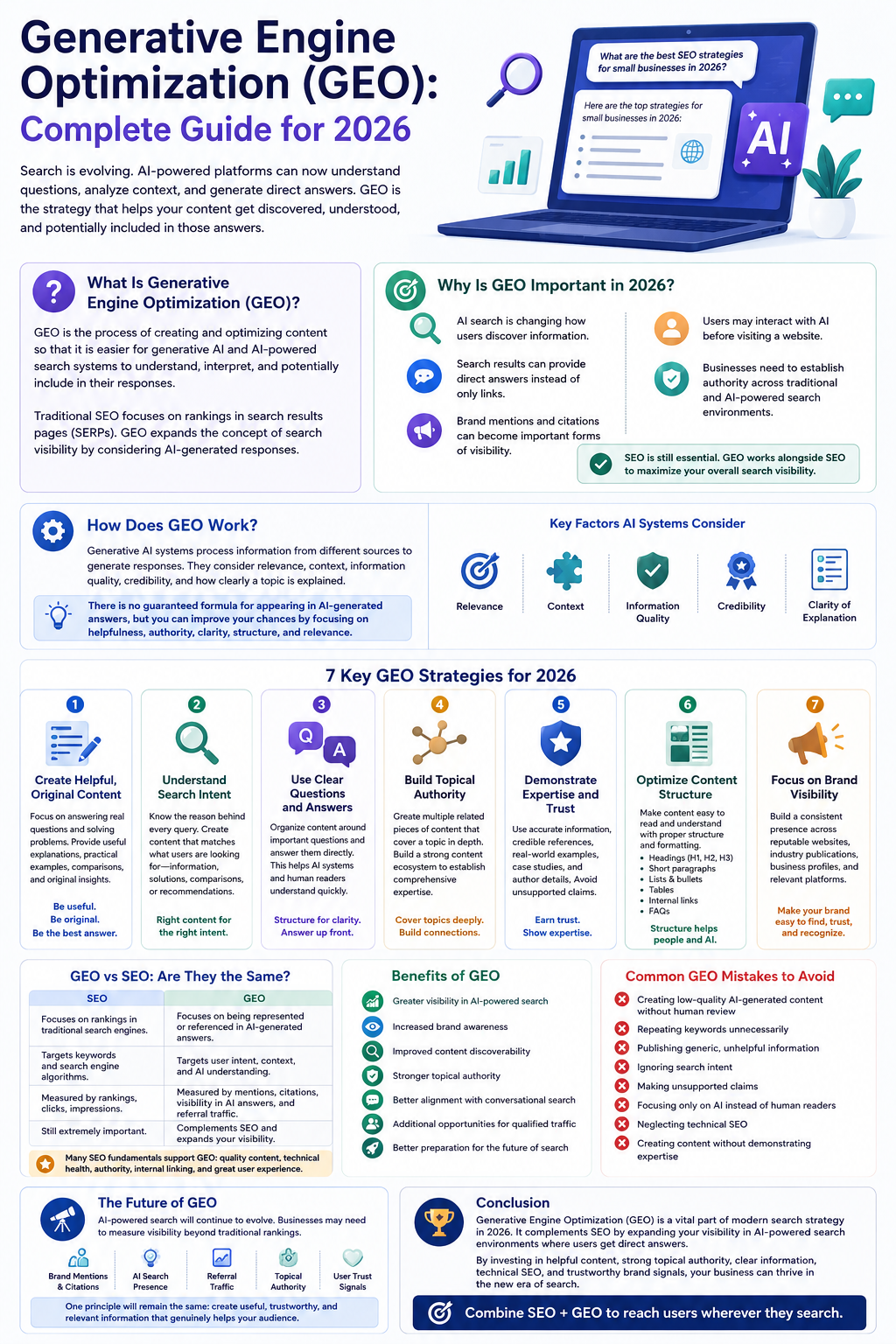
GEO stands for Generative Engine Optimization. It is an emerging optimization approach designed to improve a brand’s visibility in AI-generated search responses.
Instead of focusing only on ranking a webpage in a list of links, GEO aims to make content easier for AI systems to understand, trust, summarize, and potentially reference.
For example, if a user asks an AI search engine:
“What are the best SEO strategies for small businesses in 2026?”
The AI may provide a direct answer instead of showing only ten blue links. GEO helps businesses create content that has a better chance of being understood and included in these AI-generated responses.
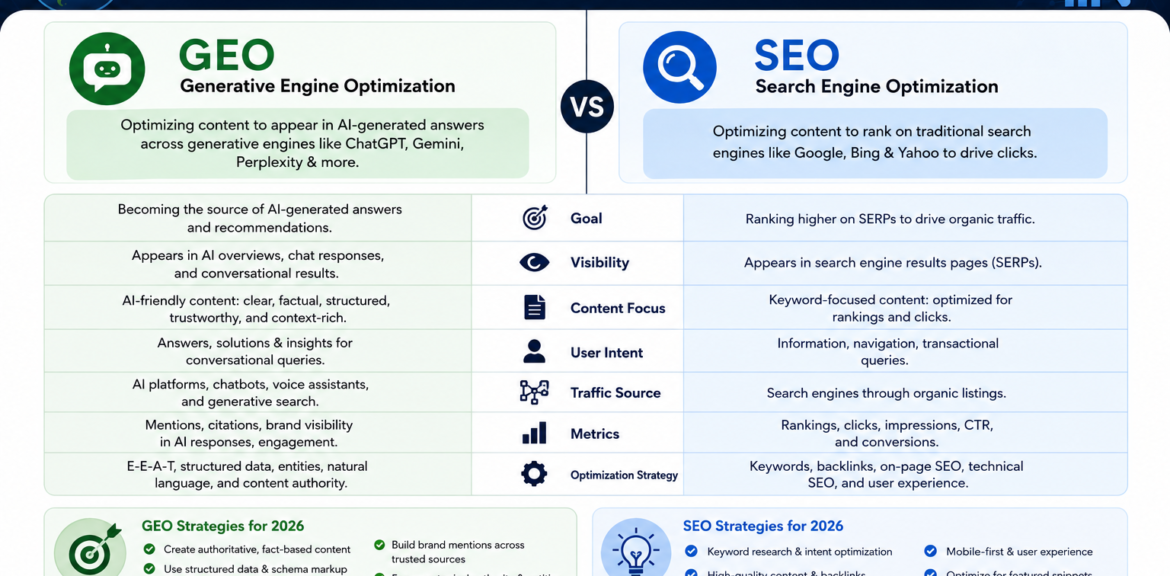
GEO vs SEO: Key Difference
The biggest difference between GEO and SEO is the search environment and optimization goal.
SEO primarily focuses on ranking in traditional search results, while GEO focuses on visibility within AI-generated answers.
| SEO | GEO |
|---|---|
| Focuses on search engine rankings | Focuses on AI-generated responses |
| Targets traditional search engines | Targets generative AI/search systems |
| Emphasizes keywords and search intent | Emphasizes context, relevance, clarity, and authority |
| Goal is higher rankings and organic traffic | Goal is AI visibility, mentions, and citations |
| Uses traditional SERP metrics | Uses emerging AI visibility metrics |
| Optimizes webpages for search engines | Optimizes information for AI understanding |
However, GEO does not mean that traditional SEO is no longer important. In fact, strong SEO can support GEO because AI systems often need reliable, well-structured information to generate useful answers.
Why GEO Is Becoming Important in 2026
AI-powered search is changing how people discover information online. Instead of visiting multiple websites, users can increasingly receive summarized answers directly from AI systems.
This creates a new challenge for businesses.
A website may have good rankings but still receive less visibility if users get their answers directly from AI-generated results.
For this reason, businesses should think beyond traditional rankings and consider how their content can become a trusted source of information for AI systems.
GEO can be particularly valuable for:
- SaaS companies
- E-commerce businesses
- Local businesses
- Digital marketing agencies
- Professional service providers
- Publishers and bloggers
- Technology companies
How to Optimize Content for GEO
There is no single guaranteed formula for appearing in AI-generated answers. However, businesses can follow several best practices.
1. Create Helpful and Original Content
AI systems need useful information to generate quality answers. Create content that genuinely solves users’ problems instead of writing content only to target keywords.
Provide practical information, examples, statistics, comparisons, and clear explanations where appropriate.
2. Answer Questions Clearly
Structure your content around real questions users ask.
For example:
- What is GEO?
- How does GEO work?
- What is the difference between GEO and SEO?
- How can businesses use GEO?
- Is GEO replacing SEO?
Clear question-and-answer sections can make information easier to understand.
3. Build Topical Authority
Create comprehensive content around your main subject instead of publishing unrelated articles.
For example, a website focusing on SEO could create content about technical SEO, keyword research, content optimization, AI search, GEO, local SEO, and SEO analytics.
This helps establish expertise around a specific topic.
4. Use Clear Content Structure
Use descriptive headings, short paragraphs, bullet points, tables, and logical sections.
Well-structured content is easier for both users and search systems to understand.
5. Demonstrate Experience and Expertise
Trust is becoming increasingly important in search.
Include accurate information, author details where relevant, original insights, real examples, case studies, and credible references. Avoid making unsupported claims.
6. Optimize for Both SEO and GEO
Businesses do not necessarily need separate SEO and GEO strategies.
A better approach is to combine them.
Continue optimizing:
- Title tags
- Meta descriptions
- Headings
- URLs
- Internal links
- Technical performance
- Keywords and search intent
At the same time, create content that is clear, authoritative, comprehensive, and useful for AI-generated answers.
Is GEO Replacing SEO?
No. GEO is not replacing SEO.
SEO remains important because traditional search engines continue to drive significant website traffic. GEO is better viewed as an additional layer of search optimization for the growing AI-powered search environment.
In 2026, businesses should think about search visibility as a broader concept rather than focusing only on traditional rankings.
A successful strategy can combine traditional SEO, content marketing, technical optimization, brand building, and GEO.
The Future of SEO and GEO
The future of search is likely to become increasingly conversational and AI-driven.
Users may ask longer, more detailed questions and expect direct answers rather than simply browsing search results.
This means businesses need to create content that is not only optimized for keywords but also useful, trustworthy, understandable, and genuinely valuable.
SEO will continue to help websites build organic visibility, while GEO can help brands adapt to AI-powered discovery.
Conclusion
SEO and GEO have different goals, but they work well together. SEO focuses primarily on improving visibility in traditional search results, while GEO focuses on increasing the likelihood of being represented in AI-generated responses.
For businesses in 2026, the smartest approach is not to choose between GEO and SEO. Instead, combine both strategies.
Create helpful content, understand user intent, build topical authority, maintain strong technical SEO, and provide trustworthy information. By doing this, your website can be better prepared for both traditional search and the rapidly evolving world of AI-powered search.